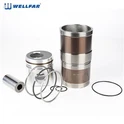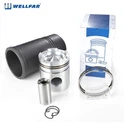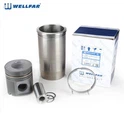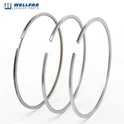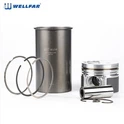
The piston head is machined with several grooves for installing piston rings. The number of piston rings depends on the sealing requirements, and it is related to the engine speed and cylinder pressure. High speed engines have fewer rings than low speed engines, and gasoline engines have fewer rings than diesel engines.

General gasoline engines use two gas rings and one oil ring; The diesel engine has three gas rings and one oil ring; Low speed diesel engine adopts 3~4 gas rings. In order to reduce friction loss, the height of the ring belt should be reduced as much as possible, and the number of rings should be reduced as much as possible under the condition of ensuring the sealing.
All parts below the piston ring groove are called piston skirts. Its function is to guide the piston to make reciprocating motion in the cylinder and bear side pressure. When the engine is working, due to the effect of the gas pressure in the cylinder, the piston will be bent and deformed. After the piston is heated, because there is more metal at the piston pin, its expansion is greater than that at other places. In addition, the piston will produce extrusion deformation under the action of side pressure. As a result of the above deformation, the cross section of the piston skirt becomes an ellipse with its long axis perpendicular to the direction of the piston pin. In addition, due to the uneven distribution of temperature and mass along the axis of the piston, the thermal expansion of each section is large at the top and small at the bottom.
Classified editing and broadcasting
As the piston of internal combustion engine works under the conditions of high temperature, high pressure and high load, the requirements for the piston are relatively high, so the classification of internal combustion engine piston is mainly discussed.
1. According to the fuel used, it can be divided into gasoline engine piston, diesel engine piston and natural gas piston.
2. According to the material of piston, it can be divided into cast iron piston, steel piston, aluminum alloy piston and combined piston.
3. It can be divided into gravity casting piston, squeeze casting piston and forging piston according to the process of manufacturing piston blanks.
4. According to the working conditions of pistons, they can be divided into non pressurized pistons and pressurized pistons.
5. Piston can be divided into car piston, truck piston, motorcycle piston, marine piston, tank piston, tractor piston, lawn mower piston, etc