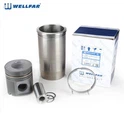
Piston rings are highly stressed mechanically, thermally, tribologically, and corrosively.
Piston rings must fulfill their task at high combustion gas temperatures and combustion pressures of up to 260 bar.
Depending on the design, up to 20% of the heat absorbed by the piston can be transferred to the cylinder wall by the piston rings.
The limit of the temperature load on the first piston ring is reached when the oil in the top ring groove starts to carbonize as a result of excessive temperature. The motion of the first piston ring, which is a requirement for its reliable function, is thereby limited. It can no longer maintain its proper contact with the cylinder surface, resulting in ring sticking. One ring-based solution is the keystone ring, developed in the early 1930s by the English engine manufacturer Napier.

Effective piston cooling is critical, as it significantly reduces the thermal load on the piston rings. Depending on the type of piston cooling, the heat flowing into the piston rings can be reduced.
During one revolution of the crankshaft, the piston moves from the top to the bottom (BDC) and back to the top dead center (TDC). It travels twice the stroke distance. During this motion, it is accelerated and decelerated. Owing to its inertia, the piston ring moves in the ring groove relative to the piston. Because of friction forces at the cylinder surface, it tends to tilt as it moves. Upon impact, it can exert forces on the side faces of the ring groove. In diesel engines, this effect is increased further by the high gas pressure.

Wear on the groove flanks degrades the function of the piston ring, until it causes ring scoring, ring failure, and, as a result, piston seizure. The introduction of aluminum pistons for diesel engines used in commercial vehicles at the beginning of the 1930s nearly failed because of this type of damage, until Ernst Mahle created an effective solution with the ring carrier as a groove protector.