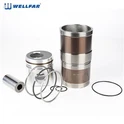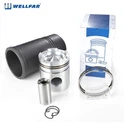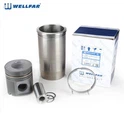
The material of piston pin is generally low carbon steel or low carbon alloy steel. In engines with low load, 15, 20, 15Cr, 20Cr and 20Mn2 steels are commonly used. On strengthened engines, advanced alloy steels such as CrNi3A, 18Cr MnTi2 and 20Si MnVB are used, and sometimes 45 medium carbon steel is also available.

In order to make the outer layer of the piston pin hard and wear-resistant, the piston pin needs to be heat-treated. For low carbon steel material, the outer surface of the piston pin is carburized and quenched. Depending on the size of the piston pin, the depth of the carburizing layer is generally in the range of 0.5-2mm. For 45 steel piston pin is surface quenched, the depth of quenching layer is 1-1.5mm.
Otherwise, the piston pin will become brittle.
The structure of piston pin is simple in shape and is basically a thick-walled hollow cylinder. The bore shape is cylindrical, two-part truncated conical and combined. The cylindrical hole is easy to process, but the piston pin has a larger mass; the piston pin with a two-section truncated conical hole has a smaller mass and is close to an equal strength beam because the piston pin has the largest bending moment in its middle part, but the conical hole is more difficult to process.