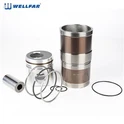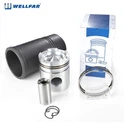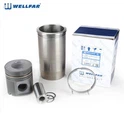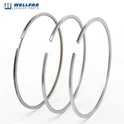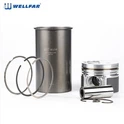
The piston rings in one piston usually consists of three piston rings: two compression rings (also known as the first and second piston rings) and an oil control ring (third piston ring).
The piston rings perform the following functions:
1st piston ring: compression of combustion air or gas mixture, and support of gas pressure in the operating cycle, dissipation of generated heat to the cylinder surface, and, to a slight degree, scraping of the residual oil from the cylinder surface.
2nd piston ring: support of the remaining gas pressure due to blow-by past the first piston ring, throttling piston land pressures and control of pressure ratios in the ring belt, scraping of oil from and dissipation of generated heat to the cylinder surface.
3rd piston ring: homogeneous distribution of the oil for lubrication of the piston group/cylinder bore tribological system and scraping of excess oil.

The force with which a piston ring presses against the cylinder wall depends mainly on the difference in diameters of the prestressed piston ring and the cylinder. This prestressing is designed in such a way that the piston ring meets the particular requirements arising from the working process and operating conditions. When the piston ring is installed in the cylinder, a tangential force is created that in turn generates the contact pressure.
The radial distribution of the contact pressure is achieved by the shape of the piston ring—for example, by CNC turning or coiling.
The radial distribution of the contact pressure depends on the shape of the running surface—cylindrical or conical—and the profile geometry of the piston ring (barrel shape).
The contact pressure is determined by the working process.
The radial pressure applied by the piston ring to the cylinder bore is small in comparison to the gas pressure applied by the ring groove in the piston to the inner side of the piston ring. In diesel engines, with their high gas pressures, the piston ring is, in many cases, shaped against the running surface such that the gas pressure acts from here against the one on the inner side, which reduces the contact pressure on the cylinder surface. Owing to the ring gap dictated by the assembly process, the piston ring cannot provide complete sealing, which leads to leakage at this point.